Weight Loss
Weight loss sounds simple when people say it quickly. Eat less. Move more. Stay consistent. In real life, it is more complicated than that because body weight changes unevenly, appetite changes with routine, motivation fades, and people often lose the plan long before they lose the desire. That is why FastNow treats weight loss as a structured process rather than a vague goal.

Inside FastNow, weight loss is the umbrella that connects fasting, calorie deficit, and walking. Fasting helps reduce eating opportunities and retrain hunger timing. Calorie control creates the actual deficit required for Fat is a macronutrient that provides a concentrated source of energy at 9 calories per gram.Full definition → loss. Walking increases daily movement in a way that is sustainable enough to support the plan over time. None of these parts is supposed to carry the whole job alone. They work better as one system than as isolated ideas.
Another important point is that weight loss and fat loss are related but not identical in the short term. The scale moves because of water, food volume, Glycogen is stored carbohydrate found in muscles and liver that the body uses for energy.Full definition →, digestion, and other factors, not just fat. That is why the FastNow weight tracker includes a trend view and 7-day rolling view. It helps you stop overreacting to one random morning number and start reading the pattern over time.
FastNow is also built around challenge windows of 30 to 180 days. That matters because long-term goals are too abstract unless they are translated into something daily and visible. A goal weight on its own does not tell you what to do today. A challenge dashboard does more of that work. It connects the target to daily calories, movement, time remaining, and the current trend.
The broader philosophy is calm and practical. Weight loss usually works better when the plan is simple enough to repeat, honest enough to measure, and flexible enough to survive real life. Most people do not need more motivation slogans. They need clearer structure and fewer blind spots. That is what this system is trying to provide.
If you are here because you want to lose weight, the next step is not to learn every theory at once. It is to choose a challenge window, set the target, and start using the core tools that make the process visible. Weight loss becomes much easier to manage when it stops being a wish and starts becoming a repeatable daily pattern.
The reason most weight loss attempts fail has nothing to do with knowing what to eat. The old pattern — the familiar loop of starting strong, drifting after a week, and eventually restarting — is simply more practiced than any new routine you try to build. That's not a character flaw; it's how repetition works. The pattern you've done a hundred times runs on autopilot. The one you started three days ago still requires effort for every decision. FastNow is built around this idea: make the new pattern simple enough to repeat, visible enough to track, and structured enough that it doesn't depend on motivation to keep going. Over time, the new pattern catches up — not because you white-knuckled it, but because you made it easier to continue than to quit.
Weight Loss App Features


Weight Tracking
Free weight tracker — log daily, edit any entry inline, and watch the trend over time.


Walking Tracker
Free walking tracker — start a timer, pick your pace, and let pause/resume handle real-life interruptions.


Calorie Tracker
Free manual calorie tracker — log meals once, save them to My Foods, and watch your daily remaining calories update live.

90-Day Challenge
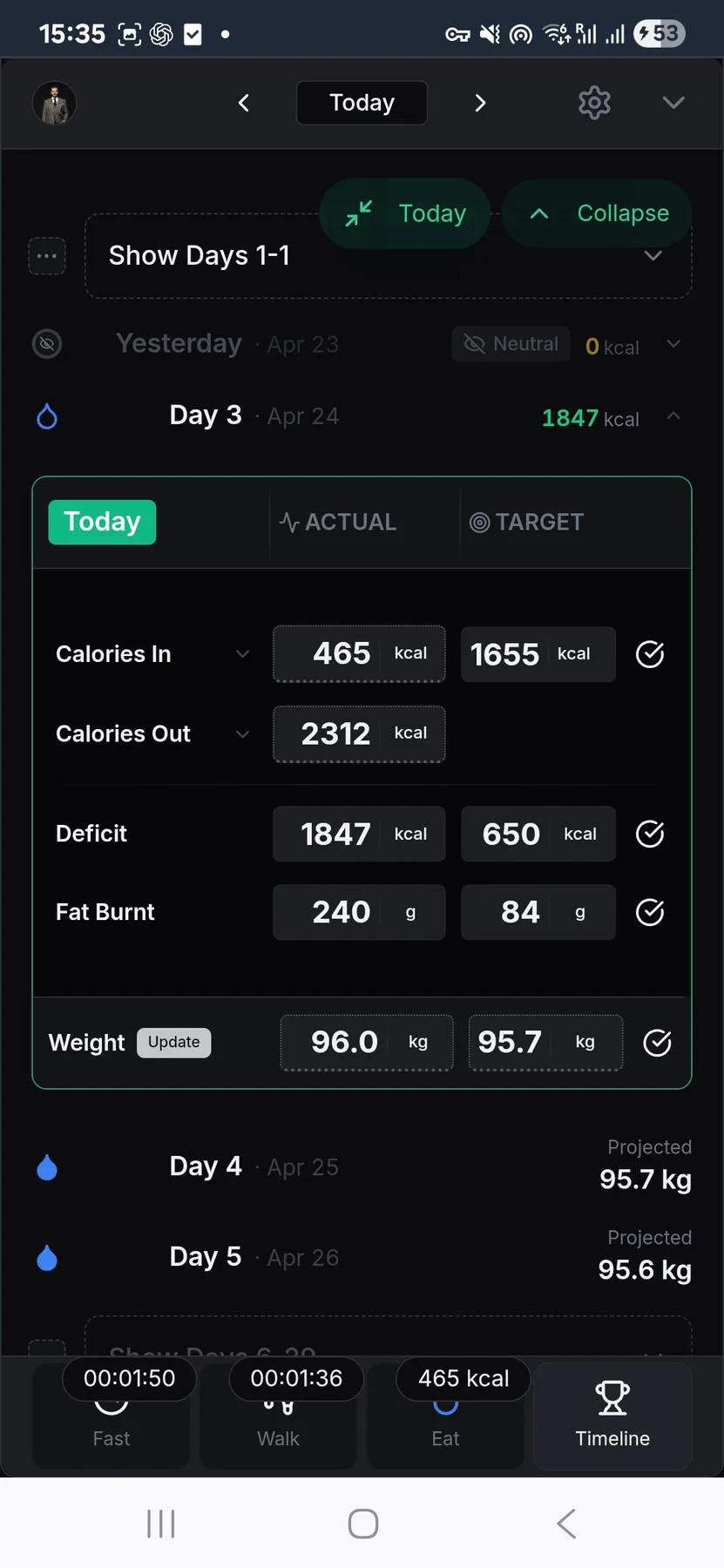
The structure layer: set a goal weight, pick 30 to 180 days, and the app aggregates every food, walking, and weight entry into one timeline.
Weight Loss in the FastNow Protocol

Weight Loss Articles

Keeping Yourself Under Control — Real Talk About Losing Control With Food
Years ago I saw a video of 50 Cent giving a tour of his house. He opened his fridge, and it contained nothing but bottled water. Nothing else. He said that th...

The 15-Step "Pants Proximity" Scale
A 15-step scale for tracking weight loss by how your pants fit, from stuck at the ankles to falling straight to the floor.
Weight Loss Calculators
Extended Fast Planner
Choose a length, then drag the fasting window to see start, finish, and duration.

Weight Loss Calculator
Estimate deficit, fat-loss pace, and practical daily outcomes.

Weight Simulator
Project timeline and trajectory toward your goal weight.

Food Calorie Calculator
Build food combinations for a calorie target and macro style.

BMI Calculator
Calculate BMI category and understand interpretation limits.
Weight Loss Glossary Terms
Adaptation phase
During this phase, progress slows as the body adjusts to recent changes. Hormones and energy use begin to stabilize at the new weight. This…
Behavior Proof
Behavior proof is the opposite of motivation. Instead of trying to believe you can change before acting, you act first and let the evidence…
Caloric Deficit
A caloric deficit forces the body to use stored energy to cover the gap between intake and demand. This is the only way fat loss occurs over…
Defended weight
The body often settles into certain weight ranges where it feels stable. Leaving this range can require more consistency and patience. Progr…
Drift
Drift is more dangerous than a single bad day because it is invisible. There is no dramatic failure to react to — just a slow slide back tow…
Food mass effect
The scale reflects everything inside your body, not just fat. After a large meal, weight can increase simply because of the food and water y…
Holding pattern
Weight can stay stable for a period even when your routine is consistent. This is often part of the normal pattern of weight loss. Internal…
Measurement lag
Fat loss does not always show up on the scale right away. The body can hold onto water for days or weeks while fat is being reduced. This cr…
Monday Restart Loop
The Monday restart loop is one of the most common patterns in weight loss. It feels productive because each restart comes with genuine motiv…
Old Pattern
Old patterns are not character flaws. They are simply more practiced than any new behavior you are trying to build. They run on autopilot be…
Pattern Break
In FastNow, the primary pattern break is the 60-hour extended fast in Phase 1. By removing all food decisions for a defined period, it inter…
Plateau
A plateau is a normal part of the weight loss process. The body may hold water or adjust energy use, which slows visible progress. This does…
Rebound weight
After eating again, weight often increases due to food, water, and glycogen returning. This change happens quickly and can feel discouraging…
Recovery Skill
Most people focus on preventing mistakes. But mistakes are inevitable — a missed fast, an untracked day, a weekend that went sideways. What…
Scale volatility
Daily weight changes are normal and often unrelated to fat. Water balance, food intake, and hormones can all affect the number. These fluctu…
Structure Over Willpower
Willpower is real but limited — it depletes throughout the day and fails under stress, fatigue, or emotional load. Structure (fixed meal tim…
Water fluctuations
Water levels in the body can change quickly based on food, salt, and activity. These changes can move the scale by several pounds in a short…
Water retention
The body can hold onto water in response to stress, food choices, or hormonal changes. This can make weight loss appear slower than it is. W…
Water weight
Water weight can change quickly and is influenced by many daily factors. It can increase or decrease without any change in body fat. This ma…
Weight floor
A weight floor is a period where the body holds a certain level before moving lower. Progress may pause while internal adjustments take plac…
Weight regain
After weight loss, some regain is normal due to food intake and water returning. This can happen quickly and may feel discouraging. It does…
Whoosh effect
The whoosh effect describes a sudden drop after a period of little change. The body releases retained water, which reveals earlier fat loss.…
Clear definitions for key terms connected to this topic.
Topics Related to Weight Loss

Calorie Deficit
A calorie deficit is the basic condition for fat loss. This page covers what it really means, why the math is the easy part, and what actually makes it hard to maintain.

Fasting
Fasting changes the structure of eating. This page covers how it works for weight loss, the difference between intermittent and extended approaches, and where it fits in a sustainable method.

Walking for Weight Loss
Why walking is one of the most underrated tools for weight loss, how it supports a calorie deficit, and how to use it as a daily habit instead of a fitness project.
Weight-Loss Plateau and Scale Fluctuations
FAQ
Can I track weight in kilograms or pounds?
Yes. Your display unit follows your profile preference, so you can view entries in kg or lbs. Internally the app stores weight in kilograms, which means switching display units later does not rewrite your historical entries or create rounding drift across the log.
Can I edit or delete a weight entry after saving it?
Yes. Tap an entry to change the number and it saves in place — there's no time limit, so you can correct an old weigh-in whenever you notice it. Delete is soft, so an accidental removal can be recovered instead of wiping the record.
How much weight history does the tracker show?
All of it. Every weigh-in you record stays in the timeline, newest first — there's no limit and nothing gets aged out. It's just date-and-weight rows meant to show your trend over time, not a stat to scrutinize daily. If you want to backfill, a Show Empty Days toggle surfaces the days you missed so you can add them.
What happens on days I do not log a weight?
Missed days stay missed. The tracker does not back-fill or invent values for gaps in your weight history. Show Empty Days can highlight skipped weigh-ins in the list, which makes the missing data visible without turning it into a moral failure. A visible gap is better than a fake clean streak.
How long before I see results?
Most people notice reduced hunger within 1-2 weeks as their body adjusts. Visible fat loss typically becomes clear after 4-6 weeks of consistent adherence.
Where do I set my goal weight?
Goal weight is editable directly on the weight screen. If you have an active 90-Day Challenge, changing the goal syncs back to that journey and recalculates the daily calorie and burn targets. A deep link can also open the add-weight modal from reminders or shortcuts.