Walking for Weight Loss
Walking is easy to underestimate because it does not look dramatic. That is exactly why it deserves more respect. For weight loss, the best form of movement is often the one you can keep doing under normal conditions, on busy days, low-energy days, and days when motivation is average. Walking fits that better than most forms of exercise.

In FastNow, walking is the third movement of the protocol. Fasting helps create structure around intake. Calorie control creates the actual deficit. Walking helps deepen that deficit through daily duration that does not usually bring heavy recovery costs or the appetite spike some people get from hard training. It is a practical tool. You are not trying to become an athlete overnight. You are trying to raise your average daily output in a way that survives real life.
This matters because many people are not failing from some giant flaw. They are just living very low-movement days. Desk work, driving, long indoor hours, screens, and convenience quietly reduce daily energy expenditure. A person can feel busy all day and still barely move. Walking helps close that gap. The simplest way to make this concrete is to think in walking time — daily walking duration, in minutes, not heroic distance. A 30-minute walk every day is more useful than a 90-minute walk twice a week. Steps and distance are useful supporting metrics, but time is the one most people can actually plan around.
Walking also works well because it is flexible. You can do it before work, after meals, during calls, in short blocks, or in one longer session. That makes it easier to repeat seven days a week. It also pairs well with weight loss because it usually does not demand much recovery. You are less likely to need a day off from walking than from hard running or intense gym sessions.
FastNow uses walking as part of a calmer strategy. You do not need to prove anything with it. You need to make it normal. A daily walking floor — say 30 to 45 minutes you can keep year-round — does more for long-term progress than chasing heroic exercise sessions you cannot maintain. Walking after meals is especially useful because it turns dead time into movement and makes the day feel less sedentary.
If this topic matters to you, the next step is simple. Look at your current baseline honestly. Then use the walking tracker to set a daily walking time you can keep. This is one of the cleanest ways to support the full weight-loss process without making your life much harder.
Walking may be the easiest behavior to build into a new routine — and that's exactly why it matters. Ambitious exercise plans often collapse under their own weight: they demand too much energy, too much recovery, too much motivation on days when motivation is already low. Walking is different. It's low enough friction to survive bad days, flexible enough to fit into almost any schedule, and repeatable enough to become automatic. That's the point. The behaviors that stick are usually the ones that don't require you to feel great in order to do them. A daily step count turns vague "I should move more" into something concrete and completable — another small vote that the new pattern is becoming the default.
Where Walking Fits in the FastNow Protocol
Walking is the repeatable activity layer in FastNow. It supports the deficit through daily duration, not intensity, so it can survive weeks where harder training does not. The aim is walking time you can actually keep.
Walking for Weight Loss App Features


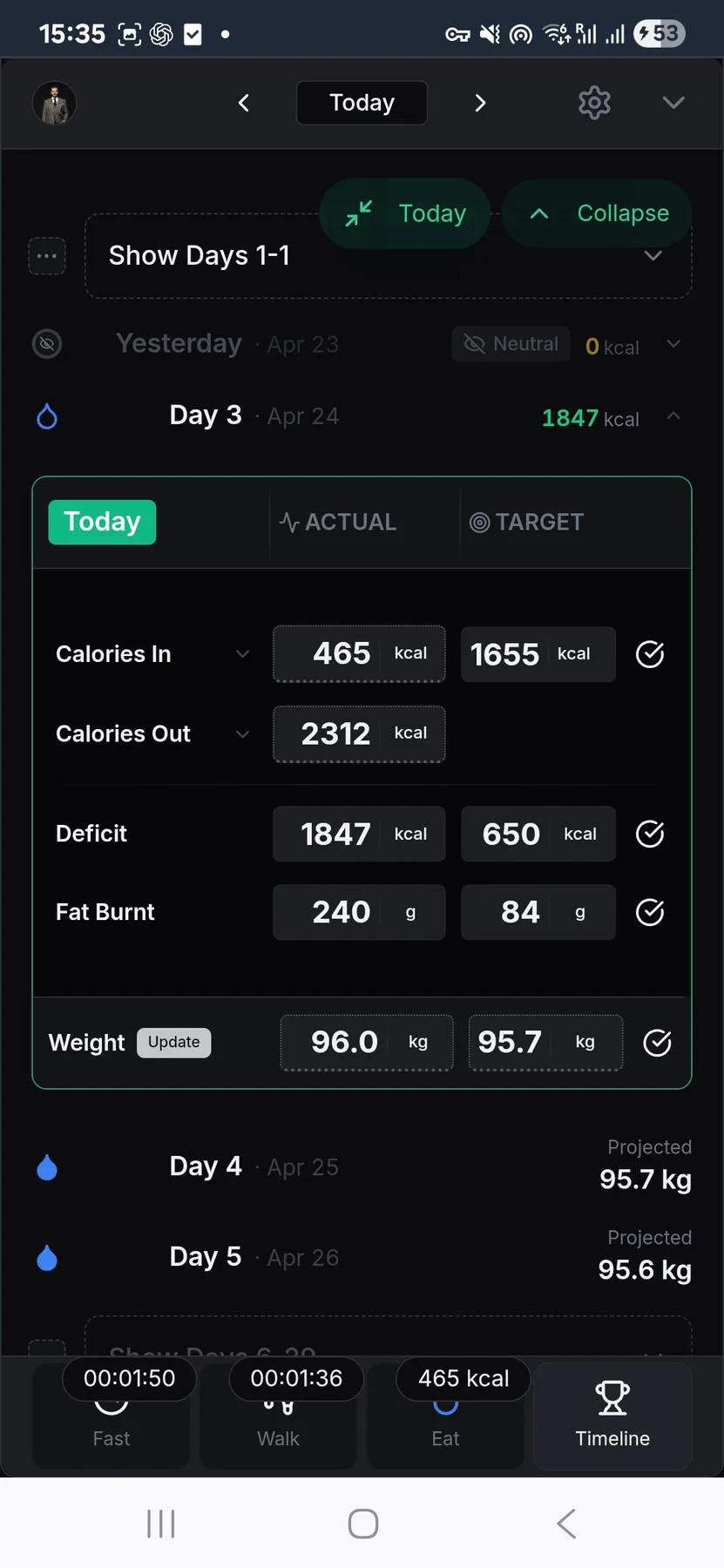
Walking for Weight Loss in the FastNow Protocol

Walking for Weight Loss Calculators

Walking for Weight Loss Glossary Terms
Action loop
This loop works because it removes complexity and keeps your focus on a few actions you can repeat every day. Fasting reduces overall intake…
Behavior Proof
Behavior proof is the opposite of motivation. Instead of trying to believe you can change before acting, you act first and let the evidence…
Recovery Skill
Most people focus on preventing mistakes. But mistakes are inevitable — a missed fast, an untracked day, a weekend that went sideways. What…
Clear definitions for key terms connected to this topic.
Topics Related to Walking for Weight Loss

Weight Loss
Weight loss is simple to describe and harder to do. This page covers what actually drives it, why progress is uneven, and how calorie deficit, fasting, and walking fit together.

Calorie Deficit
A calorie deficit is the basic condition for fat loss. This page covers what it really means, why the math is the easy part, and what actually makes it hard to maintain.
“Walking slower does not always burn fewer calories per kilometer.”
FAQ
Does the Walking Tracker use GPS or my phone step counter?
No, by default — and that's deliberate. The tracker is timer-based: tap Start, set your pace, and it estimates distance and steps from time and speed. No GPS.
The target is meant to be approximate — about 10,000 steps or 90 minutes of walking. Whether a walk lands at 9,000 or 11,000 steps doesn't change your results, and people don't vary their pace enough to throw a time-based estimate off. Exact step-counting mostly matters when someone's selling a wearable. Timing keeps it simple and keeps the focus on the part that counts — that you walked.
What happens if I pause or close the app during a walk?
Pause stops the timer while preserving elapsed time so far. Resume picks up from that point, which is useful for traffic lights, calls, or short errands. If the app closes mid-walk, the session can continue from the recorded start time when you reopen because the timestamps are what matter.
Can I fix the duration if I left the timer running?
Yes. Before saving a session, Manual Duration lets you override the final elapsed time so the log matches reality. It is a correction tool for timer mistakes, not a replacement for using the timer. Clean timing keeps the step, distance, and calorie estimates more believable.
Can I log workouts that are not walks?
Yes. Use Log Other Activity for non-walking workouts. It records a session with duration and calorie burn without miscategorising it as a walk. That keeps the walking record focused on actual walking while still letting other activity contribute to your daily burn picture.
Where do I set walking goals and review progress?
Your walking goal is a daily target in minutes — 90 minutes is the usual goal — set in your profile. That fits the timing approach: what matters is time on your feet, not a step count. The walking screen shows live progress toward today's target, and a 7-day view summarizes your recent average on the days you actually walked.
Is 10,000 steps a real target or just a marketing number?
It is more of a practical benchmark than a sacred evidence-based threshold. Plenty of people improve health and fat-loss adherence below 10,000, and others may benefit from going above it. The more useful question is whether your step target is clearly better than your current baseline and realistic enough to repeat.